Introduction
As intelligent applications become more common across industries, organizations need efficient ways to run trained models and deliver fast results. This process, known as inference, requires powerful computing resources to analyse new data and generate predictions or responses. Choosing the right hardware for inference is an important decision because it directly affects performance, scalability, and operational costs.
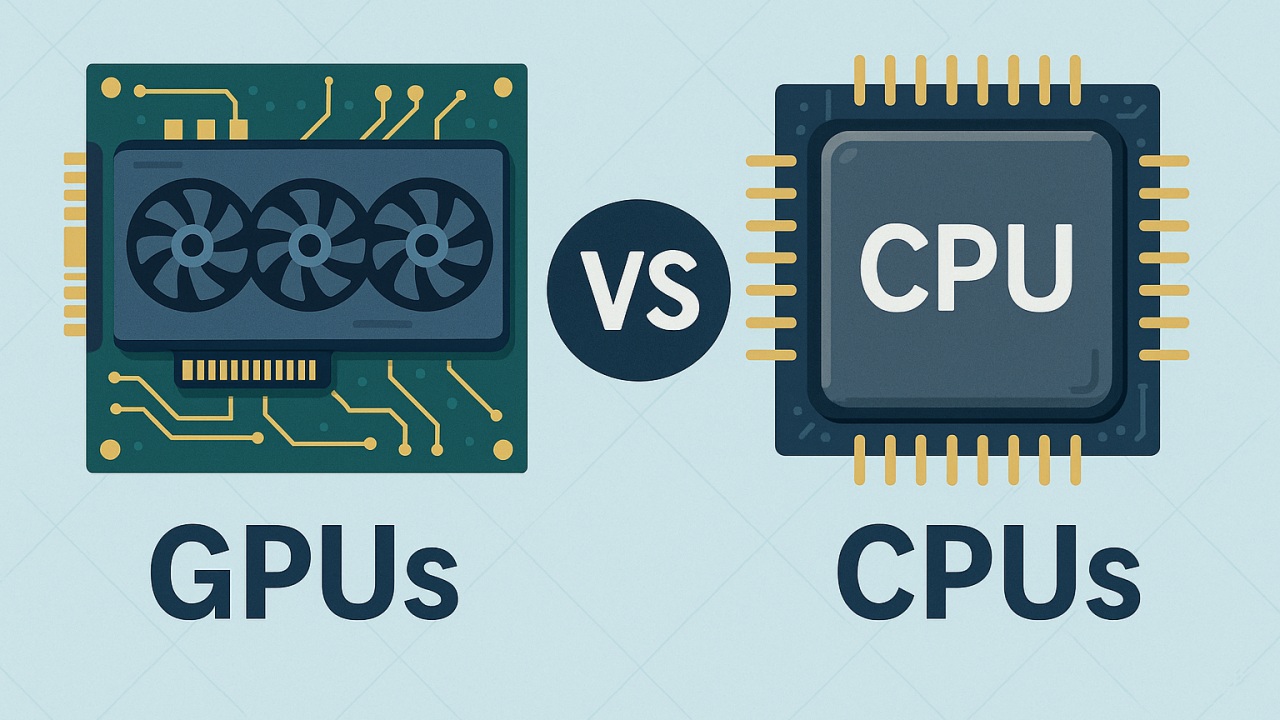
Two of the most common options for running inference workloads are Central Processing Units (CPUs) and Graphics Processing Units (GPUs). While both can support inference tasks, they are designed differently and perform better under different workload conditions.
Understanding CPU Inference
A CPU is the primary processor found in most computing systems. It is designed to handle a wide variety of tasks and is highly effective for general-purpose computing. CPU inference involves running trained models using traditional processors. CPUs are often suitable for applications that require flexibility, lower complexity, or moderate processing requirements.
Benefits of CPU Inference
1. Cost Efficiency:
CPUs are widely available and usually require a lower upfront investment compared to specialized hardware. For smaller workloads or applications with limited demand, CPU-based inference can be a practical option.
2. Simple Deployment:
Many existing applications and systems are already built around CPU environments. This makes deployment easier without requiring major infrastructure changes.
3. Lower Power Consumption:
For smaller workloads, CPUs can operate efficiently without the higher energy requirements associated with specialized accelerators.
4. Versatility:
CPUs can handle a wide range of tasks beyond inference, making them useful for general computing environments.
Understanding GPU Inference
GPUs were originally developed for graphics processing but have become highly valuable for advanced computing workloads. They contain thousands of smaller processing units that can perform many operations simultaneously.
GPU inference uses this parallel processing capability to accelerate complex workloads that require large amounts of computation.
Benefits of GPU Inference
1. High Processing Speed:
GPUs can process large volumes of data simultaneously, making them ideal for complex models and demanding applications.
2. Better Performance for Large Models:
Applications involving advanced models often require significant computational power. GPUs can handle these workloads more efficiently than traditional processors.
3. Improved Scalability:
Organizations running high-volume applications can use GPUs to process more requests and maintain faster response times.
4. Efficient Parallel Processing:
Many inference workloads involve repeated mathematical operations that GPUs can perform efficiently through parallel computing.
Key Differences Between CPU and GPU Inference
1. Processing Architecture
CPUs typically have fewer but more powerful processing cores designed for sequential tasks. GPUs have many smaller cores designed to handle multiple operations at the same time. This difference makes CPUs suitable for general workloads, while GPUs excel at highly parallel computations.
2. Speed and Performance
For small models and simple tasks, CPUs may provide sufficient performance. However, GPU inference often delivers significantly faster results for complex models and large-scale workloads. Applications requiring real-time responses and high throughput usually benefit from GPU acceleration.
3. Cost and Infrastructure Requirements
CPU-based systems are generally easier and less expensive to deploy. They are suitable for organizations with limited workloads or applications where speed is not the primary concern. GPU infrastructure requires greater investment but can provide better long-term value for organizations managing intensive workloads.
Conclusion
Selecting the right computing approach requires careful evaluation of workload requirements, performance expectations, and future growth plans. By choosing the appropriate infrastructure, organizations can improve inference efficiency, reduce operational challenges, and deliver better digital experiences.